> ## Documentation Index
> Fetch the complete documentation index at: https://docs-staging-quickstart-revamp.mintlify.site/llms.txt
> Use this file to discover all available pages before exploring further.

> This guide demonstrates how to integrate Auth0 with any new or existing Spring Boot application.

# Add Authorization to Your Spring Boot Application

export const LoggedInForm = ({sampleApp}) => {
  const LS_APPS_KEY = "auth_demo_apps";
  const LS_APP_CFG_KEY = "auth_demo_app_cfg";
  const CHANNEL = "auth_flows_sync_v1";
  const mkChannel = () => new BroadcastChannel(CHANNEL);
  function uid() {
    return Math.random().toString(36).slice(2) + Date.now().toString(36);
  }
  function loadApps() {
    const raw = localStorage.getItem(LS_APPS_KEY);
    if (raw) return JSON.parse(raw);
    const seeded = [{
      id: "mz9iNEIo2PHu7oeh8QRt19ndTyyCIgai",
      name: "Default App"
    }];
    localStorage.setItem(LS_APPS_KEY, JSON.stringify(seeded));
    return seeded;
  }
  function saveApps(apps) {
    localStorage.setItem(LS_APPS_KEY, JSON.stringify(apps));
  }
  function loadCfg() {
    const raw = localStorage.getItem(LS_APP_CFG_KEY);
    return raw ? JSON.parse(raw) : {};
  }
  function saveCfg(cfg) {
    localStorage.setItem(LS_APP_CFG_KEY, JSON.stringify(cfg));
  }
  const RightChevron = ({className = "w-5 h-5", ...props}) => <svg xmlns="http://www.w3.org/2000/svg" viewBox="0 0 24 24" stroke="currentColor" fill="none" strokeWidth="2" strokeLinecap="round" strokeLinejoin="round" className={className} {...props}>
      <polyline points="9 18 15 12 9 6" />
    </svg>;
  const LightningIcon = () => <svg width="24" height="24" viewBox="0 0 48 48" fill="none" xmlns="http://www.w3.org/2000/svg">
      <path fillRule="evenodd" clipRule="evenodd" className="fill-[#3F59E4] dark:fill-[#99A7F1]" d="M24.971 30.152H7.088c-1.786 0-2.745-2.103-1.574-3.453l19.07-21.988c1.33-1.532 3.835-.4 3.569 1.607L24.97 30.152z" />
      <path fillRule="evenodd" clipRule="evenodd" className="fill-[#3F59E4] dark:fill-[#99A7F1]" d="M23.201 17.885h17.885c1.787 0 2.746 2.102 1.575 3.453l-19.073 21.99c-1.33 1.532-3.835.4-3.568-1.607L23.2 17.885z" />
    </svg>;
  const LayersIcon = () => <svg width="24" height="24" viewBox="0 0 48 48" fill="none" xmlns="http://www.w3.org/2000/svg">
      <path className="fill-[#3F59E4] dark:fill-[#99A7F1]" d="M34.54 29.135l6.373 3.183c1.566.782 1.566 3.017 0 3.8l-14.815 7.396a4.623 4.623 0 01-4.125 0L7.174 36.12c-1.565-.782-1.565-3.017 0-3.798l6.532-3.214" />
      <path className="fill-[#AAB6F3] dark:fill-[#3449BA]" d="M34.54 18.86l6.373 3.183c1.566.782 1.566 3.016 0 3.8L26.098 33.24a4.623 4.623 0 01-4.125 0L7.174 25.843c-1.565-.781-1.565-3.016 0-3.798l6.33-3.164" />
      <path className="fill-[#CFD6F8] dark:fill-[#22307C]" d="M21.94 23.058L7.306 15.745c-1.62-.81-1.62-3.123 0-3.932l14.631-7.319a4.693 4.693 0 014.194 0l14.648 7.319c1.622.81 1.62 3.124 0 3.932L26.13 23.058c-1.321.66-2.873.66-4.191 0z" />
    </svg>;
  const GithubIcon = () => <svg xmlns="http://www.w3.org/2000/svg" viewBox="0 0 24 24" fill="none" stroke="currentColor" strokeWidth="2" strokeLinecap="round" strokeLinejoin="round" className="w-5 h-5">
      <path d="M9 19c-5 1.5-5-2.5-7-3m14 6v-3.87a3.37 3.37 0 0 0-.94-2.61c3.14-.35 6.44-1.54 6.44-7A5.44 5.44 0 0 0 20 4.77 5.07 5.07 0 0 0 19.91 1S18.73.65 16 2.48a13.38 13.38 0 0 0-7 0C6.27.65 5.09 1 5.09 1A5.07 5.07 0 0 0 5 4.77a5.44 5.44 0 0 0-1.5 3.78c0 5.42 3.3 6.61 6.44 7A3.37 3.37 0 0 0 9 18.13V22"></path>
    </svg>;
  function IconTile({children}) {
    return <div className="
          shrink-0 grid place-items-center w-10 h-10 rounded-lg
          bg-indigo-50 ring-1 ring-indigo-200/60
          dark:bg-indigo-950/40 dark:ring-white/10
        ">
        {children}
      </div>;
  }
  function Card({className = "", children}) {
    return <div className={`rounded-2xl shadow-sm ring-1 ring-zinc-200 dark:ring-zinc-800 ${className}`}>{children}</div>;
  }
  function Button({variant = "primary", type = "button", onClick, children}) {
    const base = "inline-flex items-center justify-center gap-2 h-10 px-4 rounded-xl font-medium transition";
    let styles = "";
    if (variant === "primary") {
      styles = "mint-bg-indigo-600 text-white hover:mint-bg-indigo-700";
    } else if (variant === "outline") {
      styles = "border border-zinc-300 dark:border-zinc-700 mint-bg-transparent hover:mint-bg-zinc-50 dark:hover:mint-bg-zinc-800";
    } else if (variant === "ghost") {
      styles = "hover:mint-bg-zinc-100 dark:hover:mint-bg-zinc-800";
    }
    return <button type={type} onClick={onClick} className={`${base} ${styles}`}>
        {children}
      </button>;
  }
  function Input({id, label, value, onChange, placeholder, name}) {
    return <label className="block space-y-1">
        <span className="text-sm text-zinc-700 dark:text-zinc-300">{label}</span>
        <input id={id} name={name} className="w-full h-11 px-3 rounded-xl border border-zinc-300 dark:border-zinc-700 bg-white dark:bg-zinc-900 text-zinc-900 dark:text-zinc-100 focus:outline-none focus:ring-2 focus:ring-indigo-500" placeholder={placeholder} value={value} onChange={e => onChange(e.target.value)} />
      </label>;
  }
  function Select({label, value, onChange, options}) {
    return <label className="block space-y-1 max-w-[300px]">
        <span className="text-sm text-zinc-700 dark:text-zinc-300">{label}</span>
        <div className="relative">
          <select className="w-full h-11 appearance-none px-3 pr-9 rounded-xl border border-zinc-300 dark:border-zinc-700 bg-white dark:bg-zinc-900 text-zinc-900 dark:text-zinc-100 focus:outline-none focus:ring-2 focus:ring-indigo-500" value={value} onChange={e => onChange(e.target.value)}>
            <optgroup label="Generic Applications">
              {options.map(o => <option key={o.id} value={o.id}>
                  {o.name}
                </option>)}
            </optgroup>
          </select>
          <svg className="pointer-events-none absolute right-3 top-1/2 -translate-y-1/2 w-5 h-5 text-zinc-500" viewBox="0 0 24 24">
            <path d="M7 10l5 5 5-5z" fill="currentColor" />
          </svg>
        </div>
      </label>;
  }
  function Toast({open, onClose, children}) {
    useEffect(() => {
      if (!open) return;
      const t = setTimeout(onClose, 2200);
      return () => clearTimeout(t);
    }, [open, onClose]);
    return <div className={`fixed right-4 top-4 z-50 transition ${open ? "opacity-100 translate-y-0" : "opacity-0 -translate-y-2 pointer-events-none"}`}>
        <div className="flex items-center gap-2 rounded-xl shadow ring-1 ring-emerald-200 bg-white dark:bg-zinc-900 px-4 py-2">
          <span className="w-1.5 h-8 rounded-l bg-emerald-500" />
          <svg className="w-5 h-5 text-emerald-600" viewBox="0 0 24 24" fill="none" stroke="currentColor" strokeWidth="2">
            <path d="M20 6L9 17l-5-5" />
          </svg>
          <span className="text-sm text-zinc-900 dark:text-zinc-100">{children}</span>
        </div>
      </div>;
  }
  function Flows() {
    const [route, setRoute] = useState("menu");
    const [apps, setApps] = useState(loadApps());
    const [cfg, setCfg] = useState(loadCfg());
    const [selected, setSelected] = useState(apps[0]?.id || "");
    const [toast, setToast] = useState(false);
    const [bc] = useState(() => mkChannel());
    useEffect(() => {
      if (!apps.find(a => a.id === selected)) {
        setSelected(apps[0]?.id || "");
      }
    }, [apps, selected]);
    useEffect(() => {
      const onMsg = e => {
        const {type, payload} = e.data || ({});
        switch (type) {
          case "NAV":
            setRoute(payload.route);
            break;
          case "SELECT":
            setSelected(payload.appId);
            break;
          case "APPS_UPDATED":
            setApps(loadApps());
            break;
          case "CFG_UPDATED":
            setCfg(loadCfg());
            setToast(true);
            break;
          default:
            break;
        }
      };
      bc.addEventListener("message", onMsg);
      return () => bc.removeEventListener("message", onMsg);
    }, [bc]);
    const nav = nextRoute => {
      setRoute(nextRoute);
      bc.postMessage({
        type: "NAV",
        payload: {
          route: nextRoute
        }
      });
    };
    const selectApp = appId => {
      setSelected(appId);
      bc.postMessage({
        type: "SELECT",
        payload: {
          appId
        }
      });
    };
    const onCreate = name => {
      const id = uid();
      const next = [...apps, {
        id,
        name: name || "Untitled"
      }];
      setApps(next);
      saveApps(next);
      bc.postMessage({
        type: "APPS_UPDATED"
      });
      selectApp(id);
      nav("integrate");
    };
    const onSaveCfg = (appId, data) => {
      const next = {
        ...cfg,
        [appId]: data
      };
      setCfg(next);
      saveCfg(next);
      setToast(true);
      bc.postMessage({
        type: "CFG_UPDATED"
      });
    };
    return <div>
        {route === "menu" && <Menu onCreate={() => nav("create")} onIntegrate={() => nav("integrate")} />}

        {route === "create" && <CreateForm onCancel={() => nav("menu")} onSave={onCreate} />}

        {route === "integrate" && <IntegrateForm apps={apps} selected={selected} onSelect={selectApp} saved={cfg[selected]} onSave={data => onSaveCfg(selected, data)} onCancel={() => nav("menu")} />}

        <Toast open={toast} onClose={() => setToast(false)}>
          Successfully saved your changes.
        </Toast>
      </div>;
  }
  function Menu({onCreate, onIntegrate}) {
    return <ul className="space-y-4 list-none login_list">
        <li className="list-none !px-0">
          <button onClick={onCreate} className="w-full text-left">
            <Card className="p-5 hover:shadow-md transition">
              <div className="flex items-center justify-between">
                <div className="flex items-center gap-4">
                  <IconTile>
                    <LightningIcon />
                  </IconTile>
                  <h2 className="text-lg">Create a new application</h2>
                </div>
                <RightChevron className="w-4 h-4 text-zinc-500" />
              </div>
            </Card>
          </button>
        </li>
        <li className="list-none !px-0">
          <button onClick={onIntegrate} className="w-full text-left">
            <Card className="p-5 hover:shadow-md transition">
              <div className="flex items-center justify-between">
                <div className="flex items-center gap-4">
                  <IconTile>
                    <LayersIcon />
                  </IconTile>
                  <h2 className="text-lg">Integrate with an existing application</h2>
                </div>
                <RightChevron className="w-4 h-4 text-zinc-500" />
              </div>
            </Card>
          </button>
        </li>
        <li className="list-none !px-0">
          <a className="no_external_icon block" href={sampleApp ? sampleApp : "/"} target="_blank" rel="noreferrer">
            <Card className="p-5 hover:shadow-md transition">
              <div className="flex items-center justify-between">
                <div className="flex items-center gap-4">
                  <IconTile>
                    <GithubIcon />
                  </IconTile>
                  <h2 className="text-lg">View a sample application</h2>
                </div>
                <RightChevron className="w-4 h-4 text-zinc-500" />
              </div>
            </Card>
          </a>
        </li>
      </ul>;
  }
  function CreateForm({onSave, onCancel}) {
    const [name, setName] = useState("");
    return <div className="space-y-6">
        <Input id="app-name" label="Application Name" placeholder="My App" value={name} onChange={setName} />
        <p className="text-sm text-zinc-500">You can change this later in the application settings.</p>
        <div className="flex gap-3">
          <Button onClick={() => onSave(name)}>Save</Button>
          <Button variant="outline" onClick={onCancel}>
            Cancel
          </Button>
        </div>
      </div>;
  }
  function IntegrateForm({apps, selected, onSelect, saved, onSave, onCancel}) {
    const [callbacks, setCallbacks] = useState(saved?.callbacks ?? "");
    const [logouts, setLogouts] = useState(saved?.logouts ?? "");
    const [origins, setOrigins] = useState(saved?.origins ?? "");
    useEffect(() => {
      setCallbacks(loadCfg()[selected]?.callbacks ?? "");
      setLogouts(loadCfg()[selected]?.logouts ?? "");
      setOrigins(loadCfg()[selected]?.origins ?? "");
    }, [selected]);
    return <div className="space-y-6">
        <div>
          <span className="block text-sm text-zinc-600 dark:text-zinc-300 mb-1">Select your Application</span>
          <Select label="" value={selected} onChange={onSelect} options={apps} />
        </div>

        <form className="space-y-4" onSubmit={e => {
      e.preventDefault();
      onSave({
        callbacks,
        logouts,
        origins
      });
    }}>
          <Input id="callbacks" name="callbacks" label="Callback URLs" placeholder="http://localhost:3000" value={callbacks} onChange={setCallbacks} />
          <Input id="logout" name="allowed_logout_urls" label="Logout URLs" placeholder="http://localhost:3000" value={logouts} onChange={setLogouts} />
          <Input id="origins" name="web_origins" label="Allowed Web Origins" placeholder="http://localhost:3000" value={origins} onChange={setOrigins} />

          <div className="flex gap-3 pt-2">
            <Button type="submit">Save</Button>
            <Button variant="outline" type="button" onClick={onCancel}>
              Cancel
            </Button>
          </div>
        </form>
      </div>;
  }
  return <div className="w-full mx-auto py-8">
      <Flows />
    </div>;
};

export const SignUpForm = () => {
  return <div className="flex flex-col gap-2 items-center h-full">
      <img noZoom src="/docs/img/quickstarts/action_hero_dashboard.svg" alt="Sign up for an Auth0 account" style={{
    width: "250px",
    height: "250px"
  }} />
      <span className="text-center" style={{
    width: "400px"
  }}>
        Sign up for an{" "}
        <a href="https://auth0.com/signup" target="_blank" rel="noopener noreferrer">
          Auth0 account
        </a>{" "}
        or{" "}
        <span className="font-semibold text-primary cursor-pointer" onClick={() => console.log("log in")}>
          log in
        </span>{" "}
        to your existing account to integrate directly with your own tenant.
      </span>
      <button onClick={() => console.log("sign up")} className="bg-primary dark:bg-primary-light text-white dark:text-black px-4 py-2 rounded-md mt-4 font-medium" style={{
    width: "140px"
  }}>
        Sign up
      </button>
    </div>;
};

export const SideMenuSectionItem = ({id, children}) => {
  return <div id={`side-menu-item-${id}`} className="recipe-side-menu-item flex flex-col w-full h-full">
      {children}
    </div>;
};

export const SideMenu = ({sections, children}) => {
  const [visibleSection, setVisibleSection] = useState(sections[0]?.id ?? null);
  const checkVisibility = () => {
    let currentVisible = null;
    const viewportHeight = window.innerHeight;
    const scrollY = window.scrollY;
    sections.forEach(({id}) => {
      const section = document.getElementById(id);
      if (section) {
        const rect = section.getBoundingClientRect();
        const sectionTop = rect.top + scrollY;
        const sectionBottom = sectionTop + rect.height;
        const multiplier = viewportHeight > 1600 ? 0.34 : 0.22;
        if (scrollY + viewportHeight * multiplier >= sectionTop && scrollY <= sectionBottom) {
          currentVisible = id;
        }
      }
    });
    if (currentVisible && currentVisible !== visibleSection) {
      setVisibleSection(currentVisible);
    }
  };
  useEffect(() => {
    const throttledCheck = () => {
      setTimeout(checkVisibility, 100);
    };
    checkVisibility();
    window.addEventListener("scroll", throttledCheck);
    return () => {
      window.removeEventListener("scroll", throttledCheck);
    };
  }, [sections, visibleSection]);
  useEffect(() => {
    sections.forEach(({id}) => {
      const section = document.getElementById(id);
      const sideMenuItem = document.getElementById(`side-menu-item-${id}`);
      if (section) {
        if (id === visibleSection) {
          section.classList.add("active-section");
        } else {
          section.classList.remove("active-section");
        }
      }
      if (sideMenuItem) {
        if (id === visibleSection) {
          sideMenuItem.classList.add("active-side-menu-item");
        } else {
          sideMenuItem.classList.remove("active-side-menu-item");
        }
      }
    });
  }, [visibleSection, sections]);
  return <div className="recipe-side-menu sticky px-2 py-1" style={{
    height: "calc(100vh - 7rem)",
    top: "7rem",
    scrollMarginTop: "var(--scroll-mt)"
  }}>
      {children.map(child => {
    if (child.props.id === visibleSection) {
      return child;
    }
    return null;
  })}
    </div>;
};

export const Section = ({id, title, stepNumber, children, isSingleColumn = false}) => {
  return <div id={id} className={`recipe-section flex flex-col transition-opacity duration-200`}>
      {}
      <Step title={title} stepNumber={stepNumber} titleSize="h3">
        {children}
      </Step>
    </div>;
};

export const Content = ({title, children}) => {
  return <div className="recipe-content flex flex-col">
      {title && <h1 className="text-3xl">{title}</h1>}
      {children}
    </div>;
};

export const Recipe = ({children, isSingleColumn = false}) => {
  return <div className={`pl-4 recipe-container mx-auto grid grid-cols-1 gap-10 relative ${isSingleColumn ? "md:grid-cols-1" : "md:grid-cols-2"}`}>
      {children}
    </div>;
};

export const sections = [{
  id: "define-permissions",
  title: "Define permissions"
}, {
  id: "configure-the-sample-project",
  title: "Configure the sample project"
}, {
  id: "install-dependencies",
  title: "Install dependencies"
}, {
  id: "configure-the-resource-server",
  title: "Configure the resource server"
}, {
  id: "create-the-domain-object",
  title: "Create the Domain Object"
}, {
  id: "create-the-api-controller",
  title: "Create the API controller"
}, {
  id: "run-the-application",
  title: "Run the application"
}];

<Recipe>
  <Content>
    Auth0 allows you to quickly add authorization to your application. This guide demonstrates how to integrate Auth0
    with any new or existing Spring Boot application.

    If you have not created an API in your Auth0 dashboard yet, use the interactive selector to create a new Auth0 API
    or select an existing API that represents the project you want to integrate with.

    Review [our getting started
    guide](https://auth0.com/docs/get-started/auth0-overview/set-up-apis) to set up your first API through the Auth0 dashboard.

    Each Auth0 API uses the API Identifier, which your application needs to validate the access token.

    <Info>
      **New to Auth0?** Learn [how Auth0 works](https://auth0.com/docs/overview)
      and read about [implementing API authentication
      and authorization](https://auth0.com/docs/api-auth) using the OAuth 2.0 framework.
    </Info>

    <Section id={sections[0].id} title={sections[0].title} stepNumber="1">
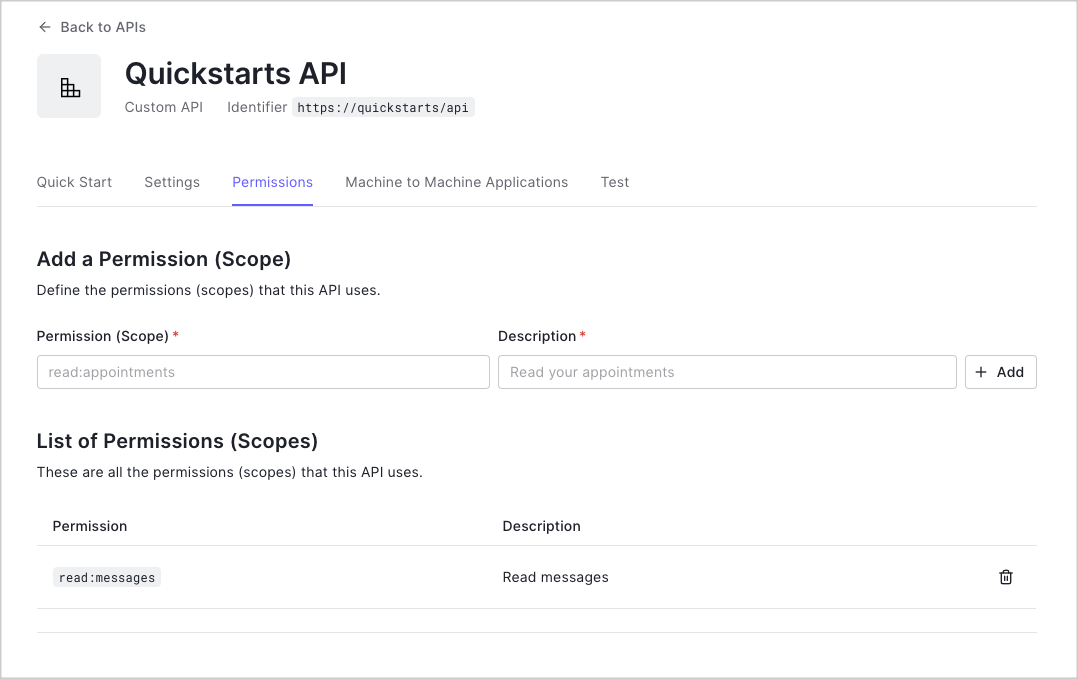
      Permissions let you define how resources can be accessed on behalf of the user with a given access token. For
      example, you might choose to grant read access to the `messages` resource if users have the manager
      access level, and a write access to that resource if they have the administrator access level.

      You can define allowed permissions in the **Permissions** view of the Auth0 Dashboard's [APIs](https://manage.auth0.com/dashboard/us/dev-1-2s2aq0/apis) section.

      <Frame>
        <img src="https://mintcdn.com/docs-staging-quickstart-revamp/fNPG21NgQLCA0axA/images/cdy7uua7fh8z/1s3Yp5zqJiKiSWqbPSezNO/e61793a2822d095666002c3f65c71ac2/configure-permissions.png?fit=max&auto=format&n=fNPG21NgQLCA0axA&q=85&s=460e697ffac537de4d7729d0e20a23ea" width="1078" height="679" data-path="images/cdy7uua7fh8z/1s3Yp5zqJiKiSWqbPSezNO/e61793a2822d095666002c3f65c71ac2/configure-permissions.png" />
      </Frame>

      <Info>
        This example uses the `read:messages` scope.
      </Info>
    </Section>

    <Section id={sections[1].id} title={sections[1].title} stepNumber="2">
      The sample project uses a `/src/main/resources/application.yml` file, which configures it to use the
      correct Auth0 **domain** and **API Identifier** for your API. If you download the code from this page it
      will be automatically configured. If you clone the example from GitHub, you will need to fill it in yourself.
    </Section>

    <Section id={sections[2].id} title={sections[2].title} stepNumber="3">
      If you are using Gradle, you can add the required dependencies using the [Spring Boot Gradle Plugin](https://docs.spring.io/spring-boot/docs/current/gradle-plugin/reference/html/) and the [Dependency Management Plugin](https://docs.spring.io/dependency-management-plugin/docs/current/reference/html/) to resolve dependency versions:

      ```gradle lines
      // build.gradle
      plugins {

          id 'java'

          id 'org.springframework.boot'

          version '3.1.5'

          id 'io.spring.dependency-management'

          version '1.1.3'

      }

      dependencies {

          implementation 'org.springframework.boot:spring-boot-starter-web'

          implementation 'com.okta.spring:okta-spring-boot-starter:3.0.5'

      }
      ```

      If you are using Maven, add the Spring dependencies to your `pom.xml` file:

      ```xml lines
      // pom.xml
      <parent>
      <groupId>org.springframework.boot</groupId>
      <artifactId>spring-boot-starter-parent</artifactId>
      <version>3.1.5</version>
      <relativePath/>
      </parent>
      <dependencies>
      <dependency>
      <groupId>org.springframework.boot</groupId>
      <artifactId>spring-boot-starter-web</artifactId>
      </dependency>
      <dependency>
      <groupId>com.okta.spring</groupId>
      <artifactId>okta-spring-boot-starter</artifactId>
      <version>3.0.5</version>
      </dependency>
      </dependencies>
      ```
    </Section>

    <Section id={sections[3].id} title={sections[3].title} stepNumber="4">
      To configure the application as a Resource Server and validate the JWTs, create a class that will provide an
      instance of `SecurityFilterChain`, and add the `@Configuration` annotation.

      ### Protect API endpoints

      The routes shown below are available for the following requests:

      * `GET /api/public`: available for non-authenticated requests
      * `GET /api/private`: available for authenticated requests containing an access token with no
        additional scopes
      * `GET /api/private-scoped`: available for authenticated requests containing an access token with
        the `read:messages`scope granted

      The example below shows how to secure API methods using the `HttpSecurity` object provided in the
      `filterChain()` method of the `SecurityConfig` class. Route matchers restrict access based
      on the level of authorization required.

      <Info>
        By default, Spring Security creates a `GrantedAuthority` for each scope in the
        `scope` claim of the JWT. This scope enables using the
        `hasAuthority("SCOPE_read:messages")` method to restrict access to a valid JWT that contains
        the `read:messages` scope.
      </Info>
    </Section>

    <Section id={sections[4].id} title={sections[4].title} stepNumber="5">
      To make your endpoint return a JSON, you can use a Java record. The member variables of this object is serialized
      into the key value for your JSON. Create a new record named `Message` as an example domain object to
      return during the API calls.
    </Section>

    <Section id={sections[5].id} title={sections[5].title} stepNumber="6">
      Create a new class named `APIController` to handle requests to the endpoints. The
      `APIController` has three routes as defined in the [Protect API Endpoints](https://auth0.com/docs/quickstart/backend/java-spring-security5/interactive#configure-the-resource-server) section. For this example, allow all origins through
      `@CrossOrigin` annotation. Real applications should configure `CORS` for their use case.
    </Section>

    <Section id={sections[6].id} title={sections[6].title} stepNumber="7">
      To build and run the sample project, execute the `bootRun` Gradle task.

      Linux or macOS:

      ```sh lines
      ./gradlew bootRun
      ```

      Windows:

      ```sh lines
      gradlew.bat bootRun
      ```

      If you are configuring your own application using Maven and the [Spring Boot Maven Plugin](https://docs.spring.io/spring-boot/docs/current/reference/html/build-tool-plugins-maven-plugin.html), you can execute the
      `spring-boot:run` goal.

      Linux or macOS:

      ```sh lines
      mvn spring-boot:run
      ```

      Windows:

      ```sh lines
      mvn.cmd spring-boot:run
      ```

      <Note>
        ##### Checkpoint

        The sample application will be available at `http://localhost:3010/`. Read about how to test
        and use your API in the [Using Your API](https://auth0.com/docs/quickstart/backend/java-spring-security5/02-using) article.
      </Note>
    </Section>
  </Content>

  <SideMenu sections={sections}>
    <SideMenuSectionItem id={sections[0].id}>
      <SignUpForm />
    </SideMenuSectionItem>

    <SideMenuSectionItem id={sections[1].id}>
      <CodeGroup>
        ```yml application.yml lines highlight={}
        okta:
          oauth2:
            # Replace with the domain of your Auth0 tenant.
            issuer: https://dev-gja8kxz4ndtex3rq.us.auth0.com/
            # Replace with the API Identifier for your Auth0 API.
            audience: {yourApiIdentifier}
        ```

        ```java SecurityConfig.java lines highlight={}
        package com.auth0.example.security;

            import org.springframework.context.annotation.Bean;
            import org.springframework.context.annotation.Configuration;
            import org.springframework.security.config.annotation.web.builders.HttpSecurity;
            import org.springframework.security.web.SecurityFilterChain;

            import static org.springframework.security.config.Customizer.withDefaults;

            /**
             * Configures our application with Spring Security to restrict access to our API endpoints.
             */
            @Configuration
            public class SecurityConfig {

        @Bean
        public SecurityFilterChain filterChain(HttpSecurity http) throws Exception {
            /*
            This is where we configure the security required for our endpoints and setup our app to serve as
            an OAuth2 Resource Server, using JWT validation.
            */
            return http
                    .authorizeHttpRequests((authorize) -> authorize
                        .requestMatchers("/api/public").permitAll()
                        .requestMatchers("/api/private").authenticated()
                        .requestMatchers("/api/private-scoped").hasAuthority("SCOPE_read:messages")
                    )
                    .cors(withDefaults())
                    .oauth2ResourceServer(oauth2 -> oauth2
                        .jwt(withDefaults())
                    )
                    .build();
        }
            }
        ```

        ```java APIController.java lines highlight={}
        ```
      </CodeGroup>
    </SideMenuSectionItem>

    <SideMenuSectionItem id={sections[2].id}>
      <CodeGroup>
        ```yml application.yml lines highlight={}
        okta:
          oauth2:
            # Replace with the domain of your Auth0 tenant.
            issuer: https://dev-gja8kxz4ndtex3rq.us.auth0.com/
            # Replace with the API Identifier for your Auth0 API.
            audience: {yourApiIdentifier}
        ```

        ```java SecurityConfig.java lines highlight={}
        package com.auth0.example.security;

            import org.springframework.context.annotation.Bean;
            import org.springframework.context.annotation.Configuration;
            import org.springframework.security.config.annotation.web.builders.HttpSecurity;
            import org.springframework.security.web.SecurityFilterChain;

            import static org.springframework.security.config.Customizer.withDefaults;

            /**
             * Configures our application with Spring Security to restrict access to our API endpoints.
             */
            @Configuration
            public class SecurityConfig {

        @Bean
        public SecurityFilterChain filterChain(HttpSecurity http) throws Exception {
            /*
            This is where we configure the security required for our endpoints and setup our app to serve as
            an OAuth2 Resource Server, using JWT validation.
            */
            return http
                    .authorizeHttpRequests((authorize) -> authorize
                        .requestMatchers("/api/public").permitAll()
                        .requestMatchers("/api/private").authenticated()
                        .requestMatchers("/api/private-scoped").hasAuthority("SCOPE_read:messages")
                    )
                    .cors(withDefaults())
                    .oauth2ResourceServer(oauth2 -> oauth2
                        .jwt(withDefaults())
                    )
                    .build();
        }
            }
        ```

        ```java APIController.java lines highlight={}
        ```
      </CodeGroup>
    </SideMenuSectionItem>

    <SideMenuSectionItem id={sections[3].id}>
      <CodeGroup>
        ```java SecurityConfig.java lines highlight={}
        package com.auth0.example.security;

            import org.springframework.context.annotation.Bean;
            import org.springframework.context.annotation.Configuration;
            import org.springframework.security.config.annotation.web.builders.HttpSecurity;
            import org.springframework.security.web.SecurityFilterChain;

            import static org.springframework.security.config.Customizer.withDefaults;

            /**
             * Configures our application with Spring Security to restrict access to our API endpoints.
             */
            @Configuration
            public class SecurityConfig {

        @Bean
        public SecurityFilterChain filterChain(HttpSecurity http) throws Exception {
            /*
            This is where we configure the security required for our endpoints and setup our app to serve as
            an OAuth2 Resource Server, using JWT validation.
            */
            return http
                    .authorizeHttpRequests((authorize) -> authorize
                        .requestMatchers("/api/public").permitAll()
                        .requestMatchers("/api/private").authenticated()
                        .requestMatchers("/api/private-scoped").hasAuthority("SCOPE_read:messages")
                    )
                    .cors(withDefaults())
                    .oauth2ResourceServer(oauth2 -> oauth2
                        .jwt(withDefaults())
                    )
                    .build();
        }
            }
        ```

        ```yml application.yml lines highlight={}
        okta:
          oauth2:
            # Replace with the domain of your Auth0 tenant.
            issuer: https://dev-gja8kxz4ndtex3rq.us.auth0.com/
            # Replace with the API Identifier for your Auth0 API.
            audience: {yourApiIdentifier}
        ```

        ```java APIController.java lines highlight={}
        ```
      </CodeGroup>
    </SideMenuSectionItem>

    <SideMenuSectionItem id={sections[4].id}>
      <CodeGroup>
        ```yml application.yml lines highlight={}
        okta:
          oauth2:
            # Replace with the domain of your Auth0 tenant.
            issuer: https://dev-gja8kxz4ndtex3rq.us.auth0.com/
            # Replace with the API Identifier for your Auth0 API.
            audience: {yourApiIdentifier}
        ```

        ```java SecurityConfig.java lines highlight={}
        package com.auth0.example.security;

            import org.springframework.context.annotation.Bean;
            import org.springframework.context.annotation.Configuration;
            import org.springframework.security.config.annotation.web.builders.HttpSecurity;
            import org.springframework.security.web.SecurityFilterChain;

            import static org.springframework.security.config.Customizer.withDefaults;

            /**
             * Configures our application with Spring Security to restrict access to our API endpoints.
             */
            @Configuration
            public class SecurityConfig {

        @Bean
        public SecurityFilterChain filterChain(HttpSecurity http) throws Exception {
            /*
            This is where we configure the security required for our endpoints and setup our app to serve as
            an OAuth2 Resource Server, using JWT validation.
            */
            return http
                    .authorizeHttpRequests((authorize) -> authorize
                        .requestMatchers("/api/public").permitAll()
                        .requestMatchers("/api/private").authenticated()
                        .requestMatchers("/api/private-scoped").hasAuthority("SCOPE_read:messages")
                    )
                    .cors(withDefaults())
                    .oauth2ResourceServer(oauth2 -> oauth2
                        .jwt(withDefaults())
                    )
                    .build();
        }
            }
        ```

        ```java APIController.java lines highlight={}
        ```
      </CodeGroup>
    </SideMenuSectionItem>

    <SideMenuSectionItem id={sections[5].id}>
      <CodeGroup>
        ```java APIController.java lines highlight={}
        ```

        ```java SecurityConfig.java lines highlight={}
        package com.auth0.example.security;

            import org.springframework.context.annotation.Bean;
            import org.springframework.context.annotation.Configuration;
            import org.springframework.security.config.annotation.web.builders.HttpSecurity;
            import org.springframework.security.web.SecurityFilterChain;

            import static org.springframework.security.config.Customizer.withDefaults;

            /**
             * Configures our application with Spring Security to restrict access to our API endpoints.
             */
            @Configuration
            public class SecurityConfig {

        @Bean
        public SecurityFilterChain filterChain(HttpSecurity http) throws Exception {
            /*
            This is where we configure the security required for our endpoints and setup our app to serve as
            an OAuth2 Resource Server, using JWT validation.
            */
            return http
                    .authorizeHttpRequests((authorize) -> authorize
                        .requestMatchers("/api/public").permitAll()
                        .requestMatchers("/api/private").authenticated()
                        .requestMatchers("/api/private-scoped").hasAuthority("SCOPE_read:messages")
                    )
                    .cors(withDefaults())
                    .oauth2ResourceServer(oauth2 -> oauth2
                        .jwt(withDefaults())
                    )
                    .build();
        }
            }
        ```

        ```yml application.yml lines highlight={}
        okta:
          oauth2:
            # Replace with the domain of your Auth0 tenant.
            issuer: https://dev-gja8kxz4ndtex3rq.us.auth0.com/
            # Replace with the API Identifier for your Auth0 API.
            audience: {yourApiIdentifier}
        ```
      </CodeGroup>
    </SideMenuSectionItem>

    <SideMenuSectionItem id={sections[6].id}>
      <SignUpForm />
    </SideMenuSectionItem>
  </SideMenu>
</Recipe>