> ## Documentation Index
> Fetch the complete documentation index at: https://docs-staging-quickstart-revamp.mintlify.site/llms.txt
> Use this file to discover all available pages before exploring further.

> Learn how you can empower your users to manage their own account information with the My Account API.

# My Account API

<Callout icon="file-lines" color="#0EA5E9" iconType="regular">
  The My Account API is available in Limited Early Access. To request access, contact your Auth0 account manager. To learn more about Auth0's product release cycle, read [Product Release Stages](/docs/troubleshoot/product-lifecycle/product-release-stages).
</Callout>

The Auth0 My Account API provides a dedicated set of endpoints for users to manage their own account information. Customers can use these APIs to build self-service experiences in their applications or progressively add details to a user account.

The My Account API operates within the context of the currently logged-in user and can be used directly within user-facing applications.

<Warning>
  **Using Auth0 domain vs. custom domain**

  The My Account API supports using your canonical Auth0 domain or your custom domain, but you must use the same one throughout the entire process, including:

  * Getting an access token
  * Setting the `audience` value
  * Calling the My Account API endpoint

  For more information, read [Custom Domains](/docs/customize/custom-domains).
</Warning>

## Activate the My Account API

You can activate the My Account API for your tenant in the <Tooltip tip="Auth0 Dashboard: Auth0's main product to configure your services." cta="View Glossary" href="/docs/glossary?term=Auth0+Dashboard">Auth0 Dashboard</Tooltip>:

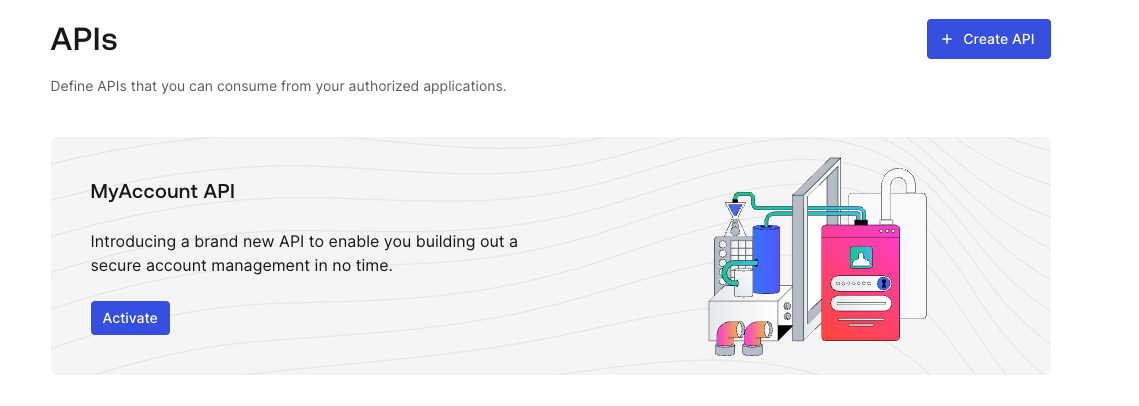
1. Navigate to **Authentication > APIs**.
2. Locate the **MyAccount API** banner.
3. Select **Activate**.

<Frame>
  <img src="https://mintcdn.com/docs-staging-quickstart-revamp/cn1eMmAiJHX3hF4T/images/cdy7uua7fh8z/DGkDQNIHcegN8vtQyEvF3/a2e98b06867701a66fa1f1b3df1c996b/My_Account_API_-_Activate.png?fit=max&auto=format&n=cn1eMmAiJHX3hF4T&q=85&s=29851a6566d13ba8e05255a0b7f7039b" alt="" width="1139" height="406" data-path="images/cdy7uua7fh8z/DGkDQNIHcegN8vtQyEvF3/a2e98b06867701a66fa1f1b3df1c996b/My_Account_API_-_Activate.png" />
</Frame>

## Get an access token

You can get an <Tooltip tip="Access Token: Authorization credential, in the form of an opaque string or JWT, used to access an API." cta="View Glossary" href="/docs/glossary?term=access+token">access token</Tooltip> for the My Account API in the same way you’d get an access token for one of your own APIs.

<Callout icon="file-lines" color="#0EA5E9" iconType="regular">
  If you’re going to allow the My Account API to perform sensitive operations (such as enrolling an authentication method), we strongly recommend that you use [step-up authentication](/docs/secure/multi-factor-authentication/step-up-authentication) to enforce additional security policies through [multi-factor authentication (MFA)](/docs/secure/multi-factor-authentication).
</Callout>

If you’re using <Tooltip tip="Universal Login: Your application redirects to Universal Login, hosted on Auth0's Authorization Server, to verify a user's identity." cta="View Glossary" href="/docs/glossary?term=Universal+Login">Universal Login</Tooltip>, read the following articles:

* [Call Your API Using the Authorization Code Flow](/docs/get-started/authentication-and-authorization-flow/authorization-code-flow/call-your-api-using-the-authorization-code-flow)
* [Call Your API Using the Authorization Code Flow with PKCE](/docs/get-started/authentication-and-authorization-flow/authorization-code-flow-with-pkce/call-your-api-using-the-authorization-code-flow-with-pkce)

If you’re using embedded login, read the following articles:

* [Call Your API Using Resource Owner Password Flow](/docs/get-started/authentication-and-authorization-flow/resource-owner-password-flow/call-your-api-using-resource-owner-password-flow)
* [Login Flow with Native Passkeys API](/docs/native-passkeys-api#login-flow)

### Audience

The <Tooltip tip="Audience: Unique identifier of the audience for an issued token. Named aud in a token, its value contains the ID of either an application (Client ID) for an ID Token or an API (API Identifier) for an Access Token." cta="View Glossary" href="/docs/glossary?term=audience">audience</Tooltip> of the My Account API is `https://{yourDomain}/me/`.

### Scope

The My Account API supports the following scopes:

<table class="table">
  <thead>
    <tr>
      <th><strong>Scope</strong></th>
      <th><strong>Description</strong></th>
    </tr>
  </thead>

  <tbody>
    <tr>
      <td><code>create:me:authentication-methods</code></td>
      <td>Allows the user to enroll a new authentication method.</td>
    </tr>
  </tbody>
</table>

### Examples

#### Universal Login with authorization code flow

##### Step 1: Request authorization code

<CodeGroup>
  ```bash cURL lines
  curl --request GET \
    --url 'https://{yourDomain}/authorize?response_type=code&client_id={yourClientId}&redirect_uri=%7ByourRedirectUri%7D&scope=create%3Ame%3Aauthentication_methods&offline_access=&audience=https%3A%2F%2F{yourDomain}%2Fme%2F'
  ```

  ```csharp C# lines
  var client = new RestClient("https://{yourDomain}/authorize?response_type=code&client_id={yourClientId}&redirect_uri=%7ByourRedirectUri%7D&scope=create%3Ame%3Aauthentication_methods&offline_access=&audience=https%3A%2F%2F{yourDomain}%2Fme%2F");
  var request = new RestRequest(Method.GET);
  IRestResponse response = client.Execute(request);
  ```

  ```go Go lines
  package main

  import (
  	"fmt"
  	"net/http"
  	"io/ioutil"
  )

  func main() {

  	url := "https://{yourDomain}/authorize?response_type=code&client_id={yourClientId}&redirect_uri=%7ByourRedirectUri%7D&scope=create%3Ame%3Aauthentication_methods&offline_access=&audience=https%3A%2F%2F{yourDomain}%2Fme%2F"

  	req, _ := http.NewRequest("GET", url, nil)

  	res, _ := http.DefaultClient.Do(req)

  	defer res.Body.Close()
  	body, _ := ioutil.ReadAll(res.Body)

  	fmt.Println(res)
  	fmt.Println(string(body))

  }
  ```

  ```java Java lines
  HttpResponse<String> response = Unirest.get("https://{yourDomain}/authorize?response_type=code&client_id={yourClientId}&redirect_uri=%7ByourRedirectUri%7D&scope=create%3Ame%3Aauthentication_methods&offline_access=&audience=https%3A%2F%2F{yourDomain}%2Fme%2F")
    .asString();
  ```

  ```javascript Node.JS lines
  var axios = require("axios").default;

  var options = {
    method: 'GET',
    url: 'https://{yourDomain}/authorize',
    params: {
      response_type: 'code',
      client_id: '{yourClientId}',
      redirect_uri: '{yourRedirectUri}',
      scope: 'create:me:authentication_methods',
      offline_access: '',
      audience: 'https://{yourDomain}/me/'
    }
  };

  axios.request(options).then(function (response) {
    console.log(response.data);
  }).catch(function (error) {
    console.error(error);
  });
  ```

  ```obj-c Obj-C lines
  #import <Foundation/Foundation.h>

  NSMutableURLRequest *request = [NSMutableURLRequest requestWithURL:[NSURL URLWithString:@"https://{yourDomain}/authorize?response_type=code&client_id={yourClientId}&redirect_uri=%7ByourRedirectUri%7D&scope=create%3Ame%3Aauthentication_methods&offline_access=&audience=https%3A%2F%2F{yourDomain}%2Fme%2F"]
                                                         cachePolicy:NSURLRequestUseProtocolCachePolicy
                                                     timeoutInterval:10.0];
  [request setHTTPMethod:@"GET"];

  NSURLSession *session = [NSURLSession sharedSession];
  NSURLSessionDataTask *dataTask = [session dataTaskWithRequest:request
                                              completionHandler:^(NSData *data, NSURLResponse *response, NSError *error) {
                                                  if (error) {
                                                      NSLog(@"%@", error);
                                                  } else {
                                                      NSHTTPURLResponse *httpResponse = (NSHTTPURLResponse *) response;
                                                      NSLog(@"%@", httpResponse);
                                                  }
                                              }];
  [dataTask resume];
  ```

  ```php PHP lines
  $curl = curl_init();

  curl_setopt_array($curl, [
    CURLOPT_URL => "https://{yourDomain}/authorize?response_type=code&client_id={yourClientId}&redirect_uri=%7ByourRedirectUri%7D&scope=create%3Ame%3Aauthentication_methods&offline_access=&audience=https%3A%2F%2F{yourDomain}%2Fme%2F",
    CURLOPT_RETURNTRANSFER => true,
    CURLOPT_ENCODING => "",
    CURLOPT_MAXREDIRS => 10,
    CURLOPT_TIMEOUT => 30,
    CURLOPT_HTTP_VERSION => CURL_HTTP_VERSION_1_1,
    CURLOPT_CUSTOMREQUEST => "GET",
  ]);

  $response = curl_exec($curl);
  $err = curl_error($curl);

  curl_close($curl);

  if ($err) {
    echo "cURL Error #:" . $err;
  } else {
    echo $response;
  }
  ```

  ```python Python lines
  import http.client

  conn = http.client.HTTPSConnection("")

  conn.request("GET", "/{yourDomain}/authorize?response_type=code&client_id={yourClientId}&redirect_uri=%7ByourRedirectUri%7D&scope=create%3Ame%3Aauthentication_methods&offline_access=&audience=https%3A%2F%2F{yourDomain}%2Fme%2F")

  res = conn.getresponse()
  data = res.read()

  print(data.decode("utf-8"))
  ```

  ```ruby Ruby lines
  require 'uri'
  require 'net/http'
  require 'openssl'

  url = URI("https://{yourDomain}/authorize?response_type=code&client_id={yourClientId}&redirect_uri=%7ByourRedirectUri%7D&scope=create%3Ame%3Aauthentication_methods&offline_access=&audience=https%3A%2F%2F{yourDomain}%2Fme%2F")

  http = Net::HTTP.new(url.host, url.port)
  http.use_ssl = true
  http.verify_mode = OpenSSL::SSL::VERIFY_NONE

  request = Net::HTTP::Get.new(url)

  response = http.request(request)
  puts response.read_body
  ```

  ```swift Swift lines
  import Foundation

  let request = NSMutableURLRequest(url: NSURL(string: "https://{yourDomain}/authorize?response_type=code&client_id={yourClientId}&redirect_uri=%7ByourRedirectUri%7D&scope=create%3Ame%3Aauthentication_methods&offline_access=&audience=https%3A%2F%2F{yourDomain}%2Fme%2F")! as URL,
                                          cachePolicy: .useProtocolCachePolicy,
                                      timeoutInterval: 10.0)
  request.httpMethod = "GET"

  let session = URLSession.shared
  let dataTask = session.dataTask(with: request as URLRequest, completionHandler: { (data, response, error) -> Void in
    if (error != nil) {
      print(error)
    } else {
      let httpResponse = response as? HTTPURLResponse
      print(httpResponse)
    }
  })

  dataTask.resume()
  ```
</CodeGroup>

##### Step 2: Exchange code for access token

<CodeGroup>
  ```bash cURL lines
  curl --request POST \
    --url 'https://{yourDomain}/oauth/token' \
    --header 'content-type: application/json' \
    --data '{"grant_type": "authorization_code","client_id": "{yourClientId}","client_secret": "{yourClientId}","code": "{yourAuthorizationCode}","redirect_uri": "{yourRedirectUri}","audience": "{yourAudience}","scope": "create:me:authentication_methods","offline_access": ""}'
  ```

  ```csharp C# lines
  var client = new RestClient("https://{yourDomain}/oauth/token");
  var request = new RestRequest(Method.POST);
  request.AddHeader("content-type", "application/json");
  request.AddParameter("application/json", "{\"grant_type\": \"authorization_code\",\"client_id\": \"{yourClientId}\",\"client_secret\": \"{yourClientId}\",\"code\": \"{yourAuthorizationCode}\",\"redirect_uri\": \"{yourRedirectUri}\",\"audience\": \"{yourAudience}\",\"scope\": \"create:me:authentication_methods\",\"offline_access\": \"\"}", ParameterType.RequestBody);
  IRestResponse response = client.Execute(request);
  ```

  ```go Go lines expandable
  package main

  import (
  	"fmt"
  	"strings"
  	"net/http"
  	"io/ioutil"
  )

  func main() {

  	url := "https://{yourDomain}/oauth/token"

  	payload := strings.NewReader("{\"grant_type\": \"authorization_code\",\"client_id\": \"{yourClientId}\",\"client_secret\": \"{yourClientId}\",\"code\": \"{yourAuthorizationCode}\",\"redirect_uri\": \"{yourRedirectUri}\",\"audience\": \"{yourAudience}\",\"scope\": \"create:me:authentication_methods\",\"offline_access\": \"\"}")

  	req, _ := http.NewRequest("POST", url, payload)

  	req.Header.Add("content-type", "application/json")

  	res, _ := http.DefaultClient.Do(req)

  	defer res.Body.Close()
  	body, _ := ioutil.ReadAll(res.Body)

  	fmt.Println(res)
  	fmt.Println(string(body))

  }
  ```

  ```java Java lines
  HttpResponse<String> response = Unirest.post("https://{yourDomain}/oauth/token")
    .header("content-type", "application/json")
    .body("{\"grant_type\": \"authorization_code\",\"client_id\": \"{yourClientId}\",\"client_secret\": \"{yourClientId}\",\"code\": \"{yourAuthorizationCode}\",\"redirect_uri\": \"{yourRedirectUri}\",\"audience\": \"{yourAudience}\",\"scope\": \"create:me:authentication_methods\",\"offline_access\": \"\"}")
    .asString();
  ```

  ```javascript Node.JS lines
  var axios = require("axios").default;

  var options = {
    method: 'POST',
    url: 'https://{yourDomain}/oauth/token',
    headers: {'content-type': 'application/json'},
    data: {
      grant_type: 'authorization_code',
      client_id: '{yourClientId}',
      client_secret: '{yourClientId}',
      code: '{yourAuthorizationCode}',
      redirect_uri: '{yourRedirectUri}',
      audience: '{yourAudience}',
      scope: 'create:me:authentication_methods',
      offline_access: ''
    }
  };

  axios.request(options).then(function (response) {
    console.log(response.data);
  }).catch(function (error) {
    console.error(error);
  });
  ```

  ```obj-c Obj-C lines expandable
  #import <Foundation/Foundation.h>

  NSDictionary *headers = @{ @"content-type": @"application/json" };
  NSDictionary *parameters = @{ @"grant_type": @"authorization_code",
                                @"client_id": @"{yourClientId}",
                                @"client_secret": @"{yourClientId}",
                                @"code": @"{yourAuthorizationCode}",
                                @"redirect_uri": @"{yourRedirectUri}",
                                @"audience": @"{yourAudience}",
                                @"scope": @"create:me:authentication_methods",
                                @"offline_access": @"" };

  NSData *postData = [NSJSONSerialization dataWithJSONObject:parameters options:0 error:nil];

  NSMutableURLRequest *request = [NSMutableURLRequest requestWithURL:[NSURL URLWithString:@"https://{yourDomain}/oauth/token"]
                                                         cachePolicy:NSURLRequestUseProtocolCachePolicy
                                                     timeoutInterval:10.0];
  [request setHTTPMethod:@"POST"];
  [request setAllHTTPHeaderFields:headers];
  [request setHTTPBody:postData];

  NSURLSession *session = [NSURLSession sharedSession];
  NSURLSessionDataTask *dataTask = [session dataTaskWithRequest:request
                                              completionHandler:^(NSData *data, NSURLResponse *response, NSError *error) {
                                                  if (error) {
                                                      NSLog(@"%@", error);
                                                  } else {
                                                      NSHTTPURLResponse *httpResponse = (NSHTTPURLResponse *) response;
                                                      NSLog(@"%@", httpResponse);
                                                  }
                                              }];
  [dataTask resume];
  ```

  ```php PHP lines expandable
  $curl = curl_init();

  curl_setopt_array($curl, [
    CURLOPT_URL => "https://{yourDomain}/oauth/token",
    CURLOPT_RETURNTRANSFER => true,
    CURLOPT_ENCODING => "",
    CURLOPT_MAXREDIRS => 10,
    CURLOPT_TIMEOUT => 30,
    CURLOPT_HTTP_VERSION => CURL_HTTP_VERSION_1_1,
    CURLOPT_CUSTOMREQUEST => "POST",
    CURLOPT_POSTFIELDS => "{\"grant_type\": \"authorization_code\",\"client_id\": \"{yourClientId}\",\"client_secret\": \"{yourClientId}\",\"code\": \"{yourAuthorizationCode}\",\"redirect_uri\": \"{yourRedirectUri}\",\"audience\": \"{yourAudience}\",\"scope\": \"create:me:authentication_methods\",\"offline_access\": \"\"}",
    CURLOPT_HTTPHEADER => [
      "content-type: application/json"
    ],
  ]);

  $response = curl_exec($curl);
  $err = curl_error($curl);

  curl_close($curl);

  if ($err) {
    echo "cURL Error #:" . $err;
  } else {
    echo $response;
  }
  ```

  ```python Python lines
  import http.client

  conn = http.client.HTTPSConnection("")

  payload = "{\"grant_type\": \"authorization_code\",\"client_id\": \"{yourClientId}\",\"client_secret\": \"{yourClientId}\",\"code\": \"{yourAuthorizationCode}\",\"redirect_uri\": \"{yourRedirectUri}\",\"audience\": \"{yourAudience}\",\"scope\": \"create:me:authentication_methods\",\"offline_access\": \"\"}"

  headers = { 'content-type': "application/json" }

  conn.request("POST", "/{yourDomain}/oauth/token", payload, headers)

  res = conn.getresponse()
  data = res.read()

  print(data.decode("utf-8"))
  ```

  ```ruby Ruby lines
  require 'uri'
  require 'net/http'
  require 'openssl'

  url = URI("https://{yourDomain}/oauth/token")

  http = Net::HTTP.new(url.host, url.port)
  http.use_ssl = true
  http.verify_mode = OpenSSL::SSL::VERIFY_NONE

  request = Net::HTTP::Post.new(url)
  request["content-type"] = 'application/json'
  request.body = "{\"grant_type\": \"authorization_code\",\"client_id\": \"{yourClientId}\",\"client_secret\": \"{yourClientId}\",\"code\": \"{yourAuthorizationCode}\",\"redirect_uri\": \"{yourRedirectUri}\",\"audience\": \"{yourAudience}\",\"scope\": \"create:me:authentication_methods\",\"offline_access\": \"\"}"

  response = http.request(request)
  puts response.read_body
  ```

  ```swift Swift lines expandable
  import Foundation

  let headers = ["content-type": "application/json"]
  let parameters = [
    "grant_type": "authorization_code",
    "client_id": "{yourClientId}",
    "client_secret": "{yourClientId}",
    "code": "{yourAuthorizationCode}",
    "redirect_uri": "{yourRedirectUri}",
    "audience": "{yourAudience}",
    "scope": "create:me:authentication_methods",
    "offline_access": ""
  ] as [String : Any]

  let postData = JSONSerialization.data(withJSONObject: parameters, options: [])

  let request = NSMutableURLRequest(url: NSURL(string: "https://{yourDomain}/oauth/token")! as URL,
                                          cachePolicy: .useProtocolCachePolicy,
                                      timeoutInterval: 10.0)
  request.httpMethod = "POST"
  request.allHTTPHeaderFields = headers
  request.httpBody = postData as Data

  let session = URLSession.shared
  let dataTask = session.dataTask(with: request as URLRequest, completionHandler: { (data, response, error) -> Void in
    if (error != nil) {
      print(error)
    } else {
      let httpResponse = response as? HTTPURLResponse
      print(httpResponse)
    }
  })

  dataTask.resume()
  ```
</CodeGroup>

#### Embedded login with native passkeys

##### Step 1: Request login challenge

<CodeGroup>
  ```bash cURL lines
  curl --request POST \
    --url 'https://{yourDomain}/passkey/challenge' \
    --header 'content-type: application/json' \
    --data '{"client_id": "{yourDomain}"}'
  ```

  ```csharp C# lines
  var client = new RestClient("https://{yourDomain}/passkey/challenge");
  var request = new RestRequest(Method.POST);
  request.AddHeader("content-type", "application/json");
  request.AddParameter("application/json", "{\"client_id\": \"{yourDomain}\"}", ParameterType.RequestBody);
  IRestResponse response = client.Execute(request);
  ```

  ```go Go lines expandable
  package main

  import (
  	"fmt"
  	"strings"
  	"net/http"
  	"io/ioutil"
  )

  func main() {

  	url := "https://{yourDomain}/passkey/challenge"

  	payload := strings.NewReader("{\"client_id\": \"{yourDomain}\"}")

  	req, _ := http.NewRequest("POST", url, payload)

  	req.Header.Add("content-type", "application/json")

  	res, _ := http.DefaultClient.Do(req)

  	defer res.Body.Close()
  	body, _ := ioutil.ReadAll(res.Body)

  	fmt.Println(res)
  	fmt.Println(string(body))

  }
  ```

  ```java Java lines
  HttpResponse<String> response = Unirest.post("https://{yourDomain}/passkey/challenge")
    .header("content-type", "application/json")
    .body("{\"client_id\": \"{yourDomain}\"}")
    .asString();
  ```

  ```javascript Node.JS lines
  var axios = require("axios").default;

  var options = {
    method: 'POST',
    url: 'https://{yourDomain}/passkey/challenge',
    headers: {'content-type': 'application/json'},
    data: {client_id: '{yourDomain}'}
  };

  axios.request(options).then(function (response) {
    console.log(response.data);
  }).catch(function (error) {
    console.error(error);
  });
  ```

  ```obj-c Obj-C lines
  #import <Foundation/Foundation.h>

  NSDictionary *headers = @{ @"content-type": @"application/json" };
  NSDictionary *parameters = @{ @"client_id": @"{yourDomain}" };

  NSData *postData = [NSJSONSerialization dataWithJSONObject:parameters options:0 error:nil];

  NSMutableURLRequest *request = [NSMutableURLRequest requestWithURL:[NSURL URLWithString:@"https://{yourDomain}/passkey/challenge"]
                                                         cachePolicy:NSURLRequestUseProtocolCachePolicy
                                                     timeoutInterval:10.0];
  [request setHTTPMethod:@"POST"];
  [request setAllHTTPHeaderFields:headers];
  [request setHTTPBody:postData];

  NSURLSession *session = [NSURLSession sharedSession];
  NSURLSessionDataTask *dataTask = [session dataTaskWithRequest:request
                                              completionHandler:^(NSData *data, NSURLResponse *response, NSError *error) {
                                                  if (error) {
                                                      NSLog(@"%@", error);
                                                  } else {
                                                      NSHTTPURLResponse *httpResponse = (NSHTTPURLResponse *) response;
                                                      NSLog(@"%@", httpResponse);
                                                  }
                                              }];
  [dataTask resume];
  ```

  ```php PHP lines expandable
  $curl = curl_init();

  curl_setopt_array($curl, [
    CURLOPT_URL => "https://{yourDomain}/passkey/challenge",
    CURLOPT_RETURNTRANSFER => true,
    CURLOPT_ENCODING => "",
    CURLOPT_MAXREDIRS => 10,
    CURLOPT_TIMEOUT => 30,
    CURLOPT_HTTP_VERSION => CURL_HTTP_VERSION_1_1,
    CURLOPT_CUSTOMREQUEST => "POST",
    CURLOPT_POSTFIELDS => "{\"client_id\": \"{yourDomain}\"}",
    CURLOPT_HTTPHEADER => [
      "content-type: application/json"
    ],
  ]);

  $response = curl_exec($curl);
  $err = curl_error($curl);

  curl_close($curl);

  if ($err) {
    echo "cURL Error #:" . $err;
  } else {
    echo $response;
  }
  ```

  ```python Python lines
  import http.client

  conn = http.client.HTTPSConnection("")

  payload = "{\"client_id\": \"{yourDomain}\"}"

  headers = { 'content-type': "application/json" }

  conn.request("POST", "/{yourDomain}/passkey/challenge", payload, headers)

  res = conn.getresponse()
  data = res.read()

  print(data.decode("utf-8"))
  ```

  ```ruby Ruby lines
  require 'uri'
  require 'net/http'
  require 'openssl'

  url = URI("https://{yourDomain}/passkey/challenge")

  http = Net::HTTP.new(url.host, url.port)
  http.use_ssl = true
  http.verify_mode = OpenSSL::SSL::VERIFY_NONE

  request = Net::HTTP::Post.new(url)
  request["content-type"] = 'application/json'
  request.body = "{\"client_id\": \"{yourDomain}\"}"

  response = http.request(request)
  puts response.read_body
  ```

  ```swift Swift lines
  import Foundation

  let headers = ["content-type": "application/json"]
  let parameters = ["client_id": "{yourDomain}"] as [String : Any]

  let postData = JSONSerialization.data(withJSONObject: parameters, options: [])

  let request = NSMutableURLRequest(url: NSURL(string: "https://{yourDomain}/passkey/challenge")! as URL,
                                          cachePolicy: .useProtocolCachePolicy,
                                      timeoutInterval: 10.0)
  request.httpMethod = "POST"
  request.allHTTPHeaderFields = headers
  request.httpBody = postData as Data

  let session = URLSession.shared
  let dataTask = session.dataTask(with: request as URLRequest, completionHandler: { (data, response, error) -> Void in
    if (error != nil) {
      print(error)
    } else {
      let httpResponse = response as? HTTPURLResponse
      print(httpResponse)
    }
  })

  dataTask.resume()
  ```
</CodeGroup>

##### Step 2: Authenticate existing user

<CodeGroup>
  ```bash cURL lines
  curl --request POST \
    --url 'https://{yourDomain}/oauth/token' \
    --header 'content-type: application/json' \
    --data '{  "grant_type": "urn:okta:params:oauth:grant-type:webauthn",  "client_id": "{yourClientId}",  "scope": "create:me:authentication_methods offline_access",  "audience": "https://{yourDomain}/me/"  "auth_session": "{sessionIdFromTheFirstRequest}",  "authn_response": "{authenticatorResponse}"}'
  ```

  ```csharp C# lines
  var client = new RestClient("https://{yourDomain}/oauth/token");
  var request = new RestRequest(Method.POST);
  request.AddHeader("content-type", "application/json");
  request.AddParameter("application/json", "{ \"grant_type\": \"urn:okta:params:oauth:grant-type:webauthn\", \"client_id\": \"{yourClientId}\", \"scope\": \"create:me:authentication_methods offline_access\", \"audience\": \"https://{yourDomain}/me/\" \"auth_session\": \"{sessionIdFromTheFirstRequest}\", \"authn_response\": \"{authenticatorResponse}\"}", ParameterType.RequestBody);
  IRestResponse response = client.Execute(request);
  ```

  ```go Go lines expandable
  package main

  import (
  	"fmt"
  	"strings"
  	"net/http"
  	"io/ioutil"
  )

  func main() {

  	url := "https://{yourDomain}/oauth/token"

  	payload := strings.NewReader("{  \"grant_type\": \"urn:okta:params:oauth:grant-type:webauthn\",  \"client_id\": \"{yourClientId}\",  \"scope\": \"create:me:authentication_methods offline_access\",  \"audience\": \"https://{yourDomain}/me/\"  \"auth_session\": \"{sessionIdFromTheFirstRequest}\",  \"authn_response\": \"{authenticatorResponse}\"}")

  	req, _ := http.NewRequest("POST", url, payload)

  	req.Header.Add("content-type", "application/json")

  	res, _ := http.DefaultClient.Do(req)

  	defer res.Body.Close()
  	body, _ := ioutil.ReadAll(res.Body)

  	fmt.Println(res)
  	fmt.Println(string(body))

  }
  ```

  ```java Java lines
  HttpResponse<String> response = Unirest.post("https://{yourDomain}/oauth/token")
    .header("content-type", "application/json")
    .body("{  \"grant_type\": \"urn:okta:params:oauth:grant-type:webauthn\",  \"client_id\": \"{yourClientId}\",  \"scope\": \"create:me:authentication_methods offline_access\",  \"audience\": \"https://{yourDomain}/me/\"  \"auth_session\": \"{sessionIdFromTheFirstRequest}\",  \"authn_response\": \"{authenticatorResponse}\"}")
    .asString();
  ```

  ```javascript Node.JS lines
  var axios = require("axios").default;

  var options = {
    method: 'POST',
    url: 'https://{yourDomain}/oauth/token',
    headers: {'content-type': 'application/json'},
    data: '{  "grant_type": "urn:okta:params:oauth:grant-type:webauthn",  "client_id": "{yourClientId}",  "scope": "create:me:authentication_methods offline_access",  "audience": "https://{yourDomain}/me/"  "auth_session": "{sessionIdFromTheFirstRequest}",  "authn_response": "{authenticatorResponse}"}'
  };

  axios.request(options).then(function (response) {
    console.log(response.data);
  }).catch(function (error) {
    console.error(error);
  });
  ```

  ```obj-c Obj-C lines
  #import <Foundation/Foundation.h>

  NSDictionary *headers = @{ @"content-type": @"application/json" };

  NSData *postData = [[NSData alloc] initWithData:[@"{  "grant_type": "urn:okta:params:oauth:grant-type:webauthn",  "client_id": "{yourClientId}",  "scope": "create:me:authentication_methods offline_access",  "audience": "https://{yourDomain}/me/"  "auth_session": "{sessionIdFromTheFirstRequest}",  "authn_response": "{authenticatorResponse}"}" dataUsingEncoding:NSUTF8StringEncoding]];

  NSMutableURLRequest *request = [NSMutableURLRequest requestWithURL:[NSURL URLWithString:@"https://{yourDomain}/oauth/token"]
                                                         cachePolicy:NSURLRequestUseProtocolCachePolicy
                                                     timeoutInterval:10.0];
  [request setHTTPMethod:@"POST"];
  [request setAllHTTPHeaderFields:headers];
  [request setHTTPBody:postData];

  NSURLSession *session = [NSURLSession sharedSession];
  NSURLSessionDataTask *dataTask = [session dataTaskWithRequest:request
                                              completionHandler:^(NSData *data, NSURLResponse *response, NSError *error) {
                                                  if (error) {
                                                      NSLog(@"%@", error);
                                                  } else {
                                                      NSHTTPURLResponse *httpResponse = (NSHTTPURLResponse *) response;
                                                      NSLog(@"%@", httpResponse);
                                                  }
                                              }];
  [dataTask resume];
  ```

  ```php PHP lines expandable
  $curl = curl_init();

  curl_setopt_array($curl, [
    CURLOPT_URL => "https://{yourDomain}/oauth/token",
    CURLOPT_RETURNTRANSFER => true,
    CURLOPT_ENCODING => "",
    CURLOPT_MAXREDIRS => 10,
    CURLOPT_TIMEOUT => 30,
    CURLOPT_HTTP_VERSION => CURL_HTTP_VERSION_1_1,
    CURLOPT_CUSTOMREQUEST => "POST",
    CURLOPT_POSTFIELDS => "{  \"grant_type\": \"urn:okta:params:oauth:grant-type:webauthn\",  \"client_id\": \"{yourClientId}\",  \"scope\": \"create:me:authentication_methods offline_access\",  \"audience\": \"https://{yourDomain}/me/\"  \"auth_session\": \"{sessionIdFromTheFirstRequest}\",  \"authn_response\": \"{authenticatorResponse}\"}",
    CURLOPT_HTTPHEADER => [
      "content-type: application/json"
    ],
  ]);

  $response = curl_exec($curl);
  $err = curl_error($curl);

  curl_close($curl);

  if ($err) {
    echo "cURL Error #:" . $err;
  } else {
    echo $response;
  }
  ```

  ```python Python lines
  import http.client

  conn = http.client.HTTPSConnection("")

  payload = "{  \"grant_type\": \"urn:okta:params:oauth:grant-type:webauthn\",  \"client_id\": \"{yourClientId}\",  \"scope\": \"create:me:authentication_methods offline_access\",  \"audience\": \"https://{yourDomain}/me/\"  \"auth_session\": \"{sessionIdFromTheFirstRequest}\",  \"authn_response\": \"{authenticatorResponse}\"}"

  headers = { 'content-type': "application/json" }

  conn.request("POST", "/{yourDomain}/oauth/token", payload, headers)

  res = conn.getresponse()
  data = res.read()

  print(data.decode("utf-8"))
  ```

  ```ruby Ruby lines
  rrequire 'uri'
  require 'net/http'
  require 'openssl'

  url = URI("https://{yourDomain}/oauth/token")

  http = Net::HTTP.new(url.host, url.port)
  http.use_ssl = true
  http.verify_mode = OpenSSL::SSL::VERIFY_NONE

  request = Net::HTTP::Post.new(url)
  request["content-type"] = 'application/json'
  request.body = "{  \"grant_type\": \"urn:okta:params:oauth:grant-type:webauthn\",  \"client_id\": \"{yourClientId}\",  \"scope\": \"create:me:authentication_methods offline_access\",  \"audience\": \"https://{yourDomain}/me/\"  \"auth_session\": \"{sessionIdFromTheFirstRequest}\",  \"authn_response\": \"{authenticatorResponse}\"}"

  response = http.request(request)
  puts response.read_body
  ```

  ```swift Swift lines
  import Foundation

  let headers = ["content-type": "application/json"]

  let postData = NSData(data: "{  "grant_type": "urn:okta:params:oauth:grant-type:webauthn",  "client_id": "{yourClientId}",  "scope": "create:me:authentication_methods offline_access",  "audience": "https://{yourDomain}/me/"  "auth_session": "{sessionIdFromTheFirstRequest}",  "authn_response": "{authenticatorResponse}"}".data(using: String.Encoding.utf8)!)

  let request = NSMutableURLRequest(url: NSURL(string: "https://{yourDomain}/oauth/token")! as URL,
                                          cachePolicy: .useProtocolCachePolicy,
                                      timeoutInterval: 10.0)
  request.httpMethod = "POST"
  request.allHTTPHeaderFields = headers
  request.httpBody = postData as Data

  let session = URLSession.shared
  let dataTask = session.dataTask(with: request as URLRequest, completionHandler: { (data, response, error) -> Void in
    if (error != nil) {
      print(error)
    } else {
      let httpResponse = response as? HTTPURLResponse
      print(httpResponse)
    }
  })

  dataTask.resume()
  ```
</CodeGroup>

## Endpoints

<Callout icon="file-lines" color="#0EA5E9" iconType="regular">
  The My Account API functionality is currently limited to [Native Passkey Enrollment](/docs/native-passkeys-api). Auth0 will add support for more self-service capabilities in the future.
</Callout>

#### Authentication methods

##### Enroll an authentication method

Allows the user to enroll a new authentication method (such as a passkey).

**ENDPOINT**

`POST https://{yourDomain}/me/authentication-methods`

**SCOPES**

`create:me:authentication-methods`

**BODY PARAMETERS**

<table class="table">
  <thead>
    <tr>
      <th><strong>Parameter</strong></th>
      <th><strong>Data type</strong></th>
      <th><strong>Required?</strong></th>
      <th><strong>Description</strong></th>
    </tr>
  </thead>

  <tbody>
    <tr>
      <td><code>type</code></td>
      <td>string</td>
      <td>Required</td>
      <td>The type of authentication method. Available values: <code>passkey</code>.</td>
    </tr>

    <tr>
      <td><code>connection</code></td>
      <td>string</td>
      <td>Optional</td>
      <td>The name of the connection on which to create the new authentication method.</td>
    </tr>

    <tr>
      <td><code>identity\_user\_id</code></td>
      <td>string</td>
      <td>Optional</td>
      <td>The identifier of the current user identity. Used with linked accounts.</td>
    </tr>
  </tbody>
</table>

## Rate limits

During Early Access, the My Account API is limited at a tenant level to 25 requests per second.
